
Learning Objectives of the Module
After the successful completion of this module, you will be able to:
Remember & Understand
• Describe the key factors that influence young athletes’ interest in supplement use
• Explain how context, relationships and prior experiences shape communication
• Recognize the role of open and supportive communication in promoting informed decision-making
Apply & Analyze
• Apply effective communication techniques, including open-ended questioning, active listening and validation
• Use clear and accessible language to communicate risks related to supplement use
• Analyze the motivations and pressures that may influence a young athlete’s interest in nutritional supplements
Evaluate & Create
• Evaluate the effectiveness of different communication approaches in fostering trust and openness
• Design constructive conversations that support safe and informed decisions about supplement use
• Develop collaborative communication strategies with coaches, medical staff and other members of the athlete’s support network
Lesson resources
Module 6 – Communication PDF
Module 6 Audio format
1. Introduction
For many parents, the topic of supplement use can feel unfamiliar, confusing, or even intimidating. You may not know much about sports nutrition, anti-doping regulations, or product safety. You may also feel unsure about what your role should be when your child starts asking questions about pills, recovery products, or performance-related routines. That uncertainty is understandable.
At the same time, conversations about supplements matter. They matter not only because of possible health or anti-doping risks, but also because these conversations often reveal something deeper: When a young athlete asks about supplements, they may not only be asking about a product. They may be expressing a multitude of underlying issues, for example insecurity, curiosity, fatigue, fear of falling behind, or a wish to keep up with others in their training environment. A conversation that looks like it is about a substance may actually be about belonging, recovery, or control. Thus, communication should not begin with judgment, but with understanding the athlete’s perspective first.
This guide is designed to support parents in exactly that situation. It does not assume specialist knowledge. It does not expect parents to become experts in sports nutrition or doping regulations. Instead, it aims to help parents communicate in a way that is calm, informed, and supportive. The goal is not to control every decision. The goal is to stay part of the decision-making process, so that safer and more informed choices become easier to make.
2. Foundations: Understanding the Young Elite Athlete
Before talking about communication strategies, it is important to understand the world in which communication takes place. Young elite athletes operate in a highly structured, demanding, and performance-oriented environment. Their decisions, reactions, and behaviors do not happen in isolation.
Many young athletes are balancing two demanding systems at once. They have to manage school and sport, often at a high level, while also moving through adolescence.
There is also the social environment around the athlete. Young athletes do not act alone. They are influenced by a variety of social influences. Additionally, young athletes may feel that they always need to appear strong, motivated, and resilient. In such environments, supplement use can start to look normal, necessary, or even expected, especially when athletes hear that “everyone is doing it” or that certain products help others recover, stay lean, gain strength, or keep up.
Parents should also keep in mind that not every pressure is visible. A young athlete may look disciplined, successful, or calm on the outside while carrying stress, insecurity, tiredness, or emotional burdens that adults do not fully see.
This is one of the most important insights for later communication: Interest in supplements does not always come from recklessness or dishonesty. Most often, it comes from understandable motives: wanting to recover better, wanting to perform well, wanting to keep up with others, wanting to feel more in control, or wanting reassurance in an environment where many things feel uncertain. Recognizing this does not mean ignoring risk. It means responding with greater perspective and less judgment.
3. Foundations: Understanding Communication
Once you begin to understand the athlete’s world, the next step is to understand communication itself. Communication may seem simple on the surface. It can be tempting to think that good communication is mainly about saying the right thing clearly, but real communication is more complex than that. Communication is not purely about transmitting information. Meaning is shaped in interaction. Context
matters just as much as previous experiences. Tone and timing matter. What one person intends is not always what the other person hears.
This is especially important in sensitive conversations about supplement use. A parent may intend to sound protective, while the child hears control. A parent may intend to sound informative, while the child hears criticism. A parent may believe they are being calm and clear, while the child experiences the conversation as dismissive, alarmist, or closed. This is why communication cannot be reduced to facts alone.
One helpful way to understand this is to move away from the idea that communication is one-directional. In real conversations, both people shape what happens. Meaning is co-created. A sentence does not arrive in a vacuum. It is filtered through the relationship, the emotional moment, the history between parent and child, and the situation in which the conversation takes place.
Let’s zoom in on context first. The same statement may land very differently depending on when and where it is said. A rushed discussion in the car after training may not have the same effect as a calmer conversation at home. A comment made in front of others may feel more threatening than the same comment in private. A child who is already tired, ashamed, or defensive may hear ordinary questions as accusations. Good communication therefore requires not only thinking about what to say, but also when to say it, where to say it, and whether the other person is emotionally able to hear it.
Another factor to consider are previous experiences. People do not enter conversations as blank slates. They bring experiences, habits, expectations, emotions, and relationship patterns with them. If a young athlete already expects to be judged, monitored, or misunderstood, even a fairly neutral statement may be interpreted as criticism or control. If they have previously felt dismissed, they may be quicker to hide information in the future. This is why it can be so helpful for parents to ask themselves not only, What do I want to say? but also, How might my child receive this, given their current stress and our relationship history?
After going into depth regarding context and field of experience, the practical takeaway is simple but powerful: successful communication is not just about getting your message across. It is about creating a conversation in which your child can still hear you, trust you, and return to you. That requires attention not only to content, but also to tone, timing, openness, and the emotional meaning of the interaction.
4. The Parent’s Role in Risk Communication about Supplement Use
After understanding the athlete’s world and the nature of communication, you can more clearly reflect on your own role in risk communication. The responsibility you carry, the role you take on for your child, and the ultimate goal of your risk communication should be treated as separate but connected pieces in need of clear refinement. That distinction is worth considering because it prevents two common problems: overreach and under-involvement.
You as a parent are important, but you are not expected to do everything. Your role is not to know every ingredient, solve all social media influence, monitor every decision, or become a sports nutrition specialist. A parent’s role includes being approachable, asking questions, offering guidance, and creating a safe space for discussion. It does not include policing every choice or acting as the final expert on every supplement-related issue.
This revelation can be freeing. You do not have to become an expert in order to be effective. What matters more is how you show up. An approachable guide stays present, remains curious, asks before advising, explains concerns clearly, and helps the child move toward safer decisions.
A particularly strong part of defining your role is goal-alignment. Just consider this before entering risk communication on supplement use:
What goal are you trying to reach?
- Not talking about supplements at all ?
- taking a prohibition-only stance ?
- over-endorsing supplement use ?
- aiming for open and transparent communication that helps the child make informed decisions !
Consider the possible outcomes to each of this goal next:
- Silence may push the conversation elsewhere.
- Strong prohibition may reduce short-term openness and increase secrecy.
- Over-endorsement may reduce critical thinking.
Open communication does not remove all risk, but it helps you remain part of the process. That is perhaps the most important conclusion for you to reach and the most strategic goal you can aim for.
When parents are clear about their role and goal, conversations often become calmer. Instead of trying to control the entire situation, you can focus on what you actually can do: listen, ask, slow things down, frame risk clearly, and support the next safe step.
5. Helpful and Unhelpful Communication Patterns
Let’s move towards more practical knowledge to learn about communication: Learning the distinction between helpful and unhelpful communication patterns.
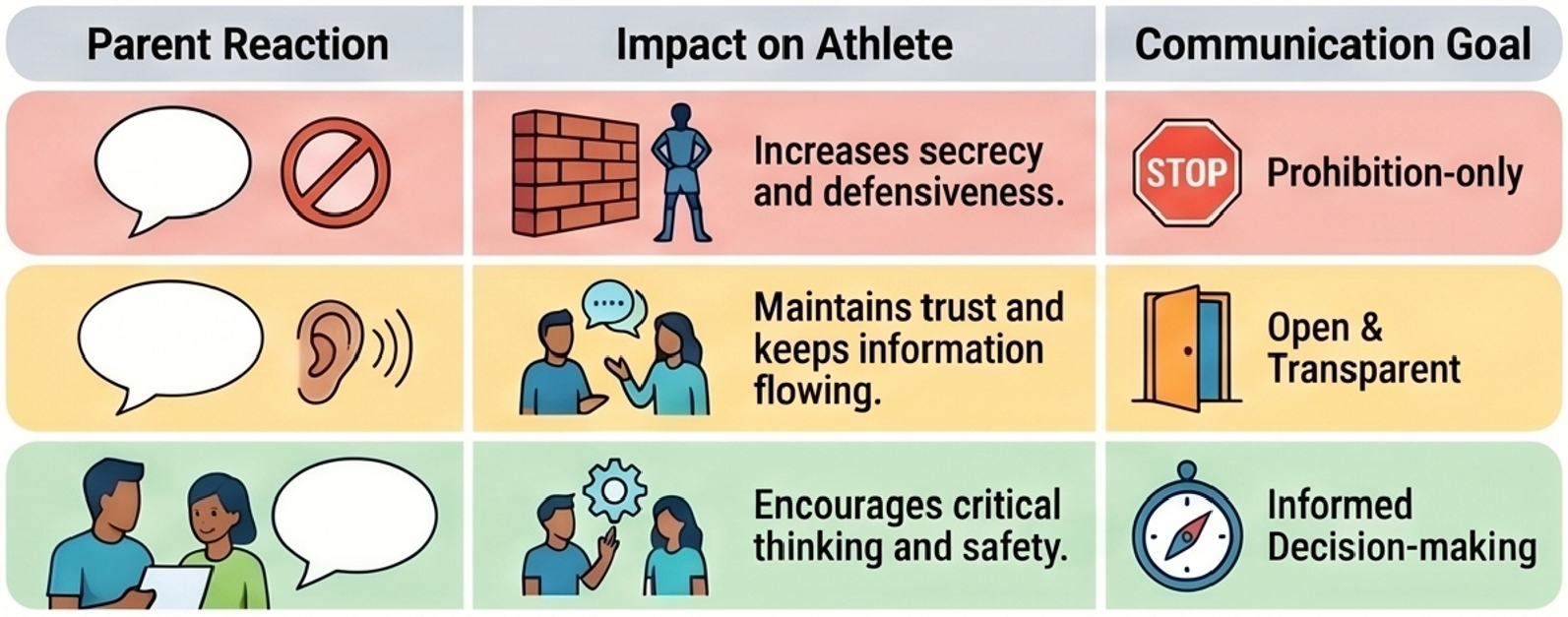
A helpful pattern is to keep disclosure open. This means staying curious and inviting the child to say more. Questions such as What did you hear?, What do you hope it would help with?, or What are you considering? keep information flowing. By contrast, shutting the topic down with phrases such as End of discussion or You don’t need that may feel protective in the moment but often push decisions underground. Curiosity keeps adults in the loop, while shutdown moves decisions out of sight.
1) Stay open and curious
A helpful pattern is to keep disclosure open. This means staying curious and inviting the child to say more. Questions such as What did you hear?, What do you hope it would help with?, or What are you considering? keep information flowing. By contrast, shutting the topic down with phrases such as End of discussion or You don’t need that may feel protective in the moment but often push decisions underground. Curiosity keeps adults in the loop, while shutdown moves decisions out of sight.
2) Validate feelings and motives
A second helpful pattern is to validate motives without endorsing risk. A parent can acknowledge that the child wants to improve, recover, or avoid falling behind, without automatically approving supplement use. This matters because shame, ridicule, or moralizing often make a child more defensive. When motives are named respectfully, the conversation becomes easier to continue. Validation reduces defensiveness, while dismissal and shame increase secrecy and conflict.
3) Support Autonomy by suggesting clear next steps
A third helpful pattern is to lead with a clear next step. Risk communication works best when it includes both concern and efficacy. Fear alone often produces anxiety, avoidance, or secrecy. But calm concern paired with a concrete next step gives the child something to do. Save the following structure: Acknowledge the issue, state the risk plainly, suggest shared checking, and invite follow-up.
4) Frame safety as pro performance
It is also helpful to frame safety as supportive of performance rather than opposed to it. Young athletes care deeply about progress. If adults speak as though safety and development are in conflict, they may unintentionally increase reactance. But if safety is framed as part of long-term performance and continuity, the message may feel more relevant and less oppositional. Enforce the idea that smart decisions protect performance and training continuity.
5) Use plain and easy language
Finally, it helps to communicate risk in plain language. Adults sometimes respond to supplement questions with either alarmist warnings or technical jargon. Both can make it harder for young athletes to understand what actually matters. Instead, use simple, concrete explanations such as Sometimes the label does not match what is inside. Comprehension drives behavior, whereas jargon can block understanding and reduce help-seeking.
6. A Practical Parent Conversation Example
To make these principles more concrete, let’s return to this scenario: It’s a weekday evening. Your 16-year-old comes home from training. While grabbing a snack, they say:
Athlete (opening):
– “Hey… apparently Leon is taking creatine and protein powder. He says it helps a lot. A bunch of people are doing it.”
Athlete (follow-up, if parent engages):
– “I mean… I’ve been thinking about it too. Not like steroids or anything. Just supplements. Everyone says it’s normal.”
Athlete (emotional cue):
– “I don’t want to fall behind. And I don’t really know what’s safe.”
A less helpful parent reaction might be immediate shutdown: You’re not taking anything. End of discussion. Another unhelpful response might be dismissal: That’s just stupid gym stuff. Or fear-only communication: Supplements are dangerous. People ruin their bodies with that. These responses may come from real concern, but they risk closing the conversation too quickly. These kinds of responses can be categorized as patterns that increase secrecy, defensiveness, or conflict.
A more helpful first reaction would stay calm and invite explanation. A parent might say: Interesting. What exactly did Leon say, and what makes it appealing to you? This kind of opener does not approve the supplement, but it keeps the conversation going. It also signals respect for the child’s perspective. Another useful line is: I get why that sounds tempting. You care about improving and not falling behind. This works because it names the motive without endorsing risky behavior.
From there, the parent can move into shared checking: Before we decide anything, let’s look at what problem you’re trying to solve — recovery, strength, stress — and then look at safer options together. Or: I can’t support taking something before we check it properly, but I’m glad you brought it up. Let’s look at what it is, what the risks are, and who we can ask for qualified advice. These kinds of responses are especially strong because they combine setting a boundary, expressing curiosity, showing risk awareness, and next-step planning.
The main lesson here is: You don’t need a perfect script. But: Wording matters because wording shapes whether the child feels safe enough to continue the conversation. Every time you replace fear, control, or shame with curiosity, validation, and shared checking, you protect something larger than the moment itself: trust.
7. Talking About Risk Clearly and Calmly
At some point, the conversation also needs to address risk directly. Parents should neither exaggerate nor minimize it. They do not need to become alarmist in order to be protective, but they also should not give the impression that all supplements are simple or harmless by default. The challenge is to explain risk clearly, calmly, and in language the child can understand.
One useful principle: Avoid fear without efficacy. Saying You’ll get banned, It will ruin your body, or Your career will be over may create anxiety, but it does not necessarily help a child think or act more safely. Instead, a more effective pattern is to name the concern plainly and then offer a next step.
Another key concept is strict liability. Simply put, strict liability is this: athletes are responsible for what ends up in their body. That means checking supplement ingredients carefully matters – a lot. The purpose of explaining this is not to frighten the child into silence, but to support careful, informed decision-making. There is a real contamination risk, and because athletes are responsible for what ends up in their body, products should be verified carefully before use.
You can also normalize uncertainty. It is perfectly reasonable to say: I don’t know yet, but I’m glad you brought this to me. Or: Let’s check this properly before deciding. These phrases reduce pressure on both sides. They allow you to remain involved without pretending certainty you do not have.
Risk communication is most effective when it is understandable, concrete, and connected to action.
You can focus on simple ideas:
- What is the product?
- Why is it being considered?
- What is known about it?
- What is unclear?
- Who can help verify it?
8. Parents as Part of a Wider Support System
Although this guide focuses on parents, the broader system still matters. Parents, coaches, and medical staff have different responsibilities but can still align around one shared goal: transparent, open communication that enables informed decisions. This convergence message is worth keeping.
Parents should not feel they need to handle everything alone. In some situations, involving other adults is the safest choice. That might be the case when a specific product is already being considered, when health questions arise, when pressure from peers seems strong, when the child becomes secretive, or when the parent feels out of their depth. Coordinating across adults and avoiding contradictory or siloed messaging is dearly recommended. Consistency protects athletes, whereas mixed messages can create confusion and increase risk.
What coordination looks like can vary. Sometimes it simply means telling the child: Let’s bring this to medical staff, or Let’s make sure we are all working from the same information. Sometimes it means aligning with a coach about general communication norms while still respecting role boundaries. The important point is that the parent does not have to become the only decision-maker. Being part of a supportive, aligned network is often more protective than trying to manage everything alone.
9. Conclusion
Conversations about supplements are not only about products. They are about the wider world in which young athletes train, perform, compare themselves, worry, and grow. For parents, that means communication begins with understanding. It helps to understand the pressures young athletes face, the complexity of communication itself, and the fact that parental influence does not depend on having perfect expertise.
You do not need to know everything in order to be helpful. You do not need to react perfectly every time. What matters most is that you remain approachable, curious, and clear. Helpful communication keeps the door open. It validates motives without ignoring risk. It explains concerns in plain language. It offers a next safe step. And it helps the child feel that bringing up difficult topics is not a mistake.
In this sense, effective communication is not about controlling every decision. It is about staying part of the decision.
Loading question…
Additional Recommended Material
1. Sport Integrity Australia (2021). Parents’ guide to support clean sport: https://www.sportintegrity.gov.au/sites/default/files/SIA141-0323-ParentsGuidetoSupportCleanSport-2%20%5BDIGITAL%5D.pdf
2. Sport Ireland (2025). Your role as a parent or guardian: https://www.sportireland.ie/sites/default/files/media/document/2025-12/Parents%20Guide%20to%20Clean%20Sport.pdf