Learning Objectives of the Module
After the successful completion of this module, you will be able to:
Remember & Understand
• Explain the appropriate role of supplements within an athlete’s overall nutrition and performance strategy.
• Identify and distinguish the 3 main categories of supplements—sports foods, performance supplements, and medical/health supplements—and describe their primary purposes.
• Describe the major safety concerns associated with supplement use, including contamination, inadvertent doping, inaccurate labelling, and the principle of strict liability.
Apply & Analyze
• Apply evidence-based criteria to select appropriate sports foods and supplements according to an athlete’s training, competition, recovery, and health needs.
• Analyze a supplement product for potential safety and doping risks by examining third-party certification, batch verification, sourcing, and the need for professional guidance.
• Analyze athlete scenarios to determine whether nutritional problems should primarily be addressed through food, training/recovery practices, or—in appropriate circumstances—supplementation.
Evaluate & Create
• Evaluate the appropriateness, effectiveness, and safety of a proposed supplement strategy by integrating scientific evidence, athlete-specific needs, potential adverse effects, and anti-doping considerations.
• Justify recommendations to athletes, parents, or coaches regarding whether a supplement should be used, avoided, or discussed with a qualified sports nutrition or medical professional.
• Develop a practical, food-first nutrition and supplementation strategy for an athlete that integrates performance goals, recovery, safety, and doping-risk management.
Lesson resources
Module 2 in PDF format
Module 2 in Audio format
1. Foundational Principles
The most critical piece of nutritional advice is to start with good basic nutritional habits. Supplements should only be used to complement a balanced diet, which remains the primary driver of an athlete’s health and performance. The contribution of supplements is generally small compared to factors like appropriate training, adequate energy intake, and overall dietary quality.
Athletic excellence is founded upon three non-negotiable pillars: scientifically programmed training, meeting total energy requirements, and high-quality nutrient intake through whole foods. Within this hierarchy, supplements serve as a secondary, elective tier.
There are two Regulatory Definitions to discuss:
- EU Directive 2002/46/EC: Food supplements are foodstuffs intended to supplement the normal diet. They are concentrated sources of nutrients or other substances with a nutritional or physiological effect, marketed in “dose form” (capsules, tablets, liquids) to be taken in measured small unit quantities.
- International Olympic Committee (IOC): A nutrition supplement is a food, food component, nutrient, or non-food compound purposefully ingested in addition to the habitual diet to achieve a specific health and/or performance benefit.
CRITICAL WARNING: The Performance Hierarchy: The contribution of supplements to athletic performance is marginal compared to the foundational impact of consistent training and diet quality. It is a dereliction of duty to prioritize supplementation over energy balance and sleep hygiene. Supplements must only complement a structured nutrition plan.
2. Navigating the Risk of Contamination and Inadvertent Doping
The supplement industry is plagued by a lack of pharmaceutical-grade oversight. Research highlights a pervasive risk of contamination that can terminate an athlete’s career.
2.1. Safety and Doping Risks: What You Must Know
Supplement use is not without risk. The industry is large, and most products are based on “wishful thinking” rather than science.
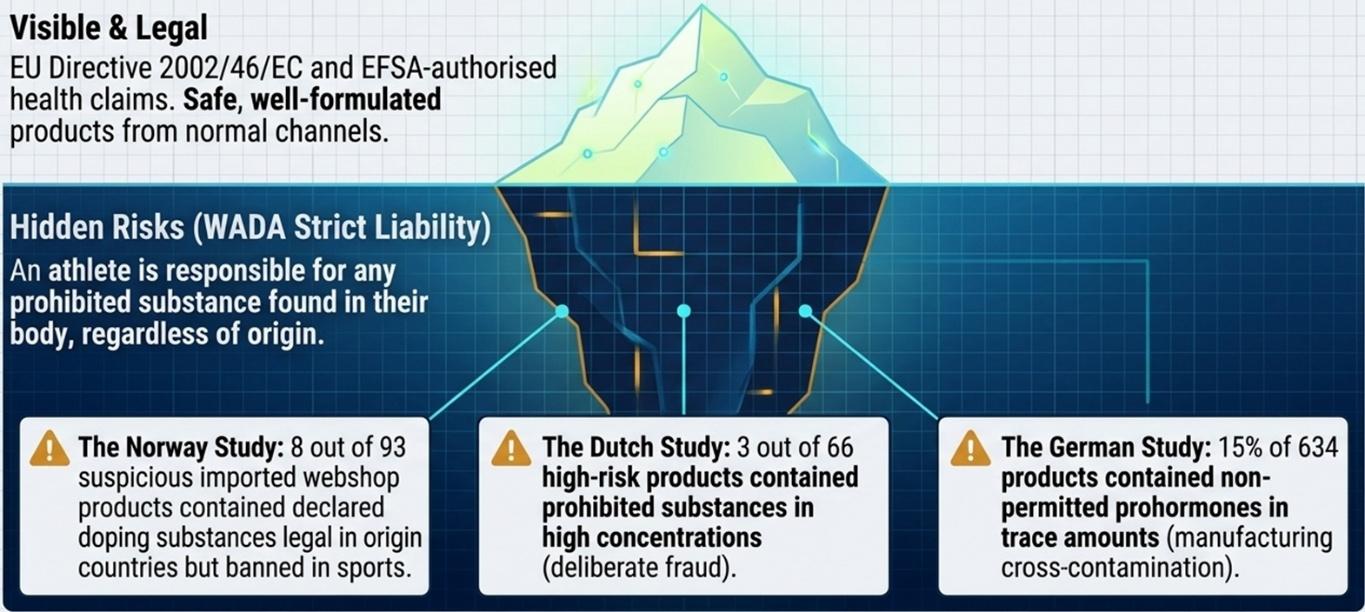
- Strict Liability: Under World Anti-Doping Agency (WADA) rules, athletes are strictly responsible for any substance found in their body. A positive test from a contaminated supplement can ruin a career.
- Contamination: Some supplements may contain banned substances not listed on the label. This can happen through cross-contamination during manufacturing or deliberate fraud.
- Webshop Risks: Products bought from online webshops, especially those from outside Europe, often have a higher risk of containing prohibited or harmful substances.
“According to the IOC consensus statement, what is the primary aim of purposefully ingesting a nutrition supplement?”
“To achieve a specific health and/or performance benefit.”
“Under the WADA principle of ‘strict liability’, who is responsible for prohibited substances found in an athlete’s sample?”
“The athlete is responsible, regardless of how the substance entered their system.”
2.2. Practical Quality Assurance Checklist
Under the World Anti-Doping Agency (WADA) Code, the principle of Strict Liability is absolute: The athlete is solely and legally responsible for every substance found in their biological sample. Ignorance, a contaminated label, or a coach’s recommendation are not valid defenses. A positive test results in a ban, period.
Non-Negotiable Verification Protocol Safety is never guaranteed by a brand name. Safety is verified at the batch level, not the brand level.
To minimize risks, parents and coaches should follow these steps before an athlete uses any supplement:
- Look for Quality Labels: Only use products that carry recognized third-party testing labels such as Informed Sport, NZVT (Netherlands), Cologne List (Germany), or HASTA.
- Check the Batch Number: Having a label on the package isn’t enough.
- Identify the Batch Number: Locate the specific batch/lot number and expiry date on the packaging (see Table 1).
- Consult Professionals: Before starting a supplement protocol, seek a comprehensive nutritional assessment from a sports dietitian or medical professional.
- “Train the Gut”: If using sports foods like gels or drinks, athletes should always test them guided by sports nutrition professionals like sports dietitians during training first to ensure they are well-tolerated before a competition.
| No. | Instrument/tool of verification | Logo |
|---|---|---|
| 1 | Informed Sport / Wetestyoutrust (sport.wetestyoutrust.com) |  |
| 2 | Cologne List / Koelnerliste (koelnerliste.com) |  |
| 3 | NSF Sport (nsfsport.com) |  |
| 4 | NZVT (dopingautoriteit.nl/nzvt) |  |
| 5 | HASTA (hasta.org.au) |  |
| 6 | BSCG (bscg.org) |  |
| 7 | Sport Protect (sport-protect.org) |  |
| Category | Primary Use | Practical Example |
|---|---|---|
| Fuelling | During sessions >60 min | Sports drinks or gels (30-90 g carbs/hour) |
| Recovery | Post-training | Chocolate milk, Greek yogurt, or 20-40 g protein |
| Performance | High-intensity efforts | Creatine (3-5 g/day) or caffeine (3-6 mg/kg) |
| Health | Deficiencies | Vitamin D (especially in winter) or iron (if diagnosed) |
2.3. Understanding Supplement Categories
Supplements are generally grouped into three main types based on their purpose:
- Sports Foods (Fuel & Recovery): These are convenient versions of nutrients found in regular food, used when eating a full meal is impractical.
- Examples: Sports drinks, energy gels, bars, and protein powders (whey/casein).
- Goal: To support fuelling during training and promote recovery afterward.
- Performance Supplements (The “Extras”): These aim to directly improve physiological functions during exercise.
- Examples: Creatine, caffeine, and beta-alanine.
- Note: These should be used strategically and are only effective under specific conditions.
- Medical/Health Supplements: Used to prevent or treat nutrient deficiencies based on a clinical assessment.
- Examples: Iron, Vitamin D, and Calcium.
- Advice: These should be taken under professional medical guidance.
2.4. The Reality of Contamination and Adulteration
Dietary supplements are not always manufactured under conditions that guarantee their purity, safety, or accurate labelling. For athletes, this creates a particular concern because prohibited substances may be present either unintentionally through cross-contamination or intentionally through adulteration. Research from several European countries illustrates three important sources of risk:
- Production Facility Risk: A landmark German study found that while 15% of suspicious products contained prohibited prohormones, a staggering 46% of the companies involved also manufactured prohormones on the same production lines. This proves that cross-contamination is a systemic failure of the manufacturing environment.
- Deliberate Fraud: A Dutch study confirmed that while most suspicious products were technically clean, a minority contained high concentrations of prohibited substances, indicating deliberate, fraudulent adulteration for marketing “potency.”
- Inaccurate Labelling: Norwegian data shows that “suspicious” products often list prohibited substances on the label but remain easily accessible via unregulated international webshops.
3. Selection Criteria for Sports Foods (Macronutrient-Based)
These products provide practical sources of energy and nutrients when regular food is impractical.
3.1. Carbohydrate-based Products
Carbohydrates are the primary fuel for high-intensity effort. For events lasting 45–75 minutes, athletes should utilize “Mouth Rinsing” (swishing a carbohydrate solution for 5–10 seconds every 10–20 minutes) to stimulate CNS reward centres and enhance performance without gastrointestinal load. Warning: to prevent tooth caries you better rinse afterwards with water.
The Multi-Transportable Carbohydrate Rule Glucose absorption via SGLT1 transporters saturates at 60 g/hour. For elite endurance efforts exceeding 2.5 hours, athletes must use a glucose:fructose blend (2:1 or 1:0.8 ratio when using >60 g/h). This engages the GLUT5 transporter, allowing for oxidation rates of 90 g/hour up to a cutting-edge threshold of 120 g/hour as recently confirmed in literature (Podlogar et al., 2022).
Hydrogel Technology Products using alginate/pectin matrices are designed to gel at stomach pH (2) to accelerate gastric emptying. This is an individualized solution for athletes who experience severe GI distress at high intake rates (90 g/hour).
| Product Type | Best Use Case | CHO Concentration (%) | Practical Considerations |
|---|---|---|---|
| Sports Drinks | Simultaneous fluid/fuel for exercise >60 min. | 4-8% (4-8 g/100 ml) | Contain 4–8% carbs (glucose, sucrose, maltodextrin) and electrolytes (sodium/potassium). Contains 23-69 mg/100 ml sodium to drive thirst. |
| Sports Gels | Rapid, portable energy; race-pace fuel. | 60-70 % (highly concentrated carbs) | Must be taken with 150-250 ml water to ensure absorption and to avoid GI distress. Some contain caffeine (25–100 mg). |
| Sports Bars | Pre-exercise fuel or low-intensity phases. | 40-50 g per bar | Solid matrix slows digestion; best for non-peak intensity. Chewy versions are low-fibre for better gut tolerance. Granola versions are for lower intensity or recovery. |
| Chews | Palatable alternative to avoid flavour fatigue. | 5-10 g per piece | Useful for portion-controlled intake during endurance. |
| Hydrogel Formulations | Rapid, portable energy; race-pace fuel. | 60-70 % (highly concentrated carbs) | Use alginate/pectin to potentially reduce GI distress at very high intake rates (>60 g/h). |
| Isolated Powders | Develop personal mixes. | 100 % | Maltodextrin (low sweetness, low osmolality), dextrose/glucose (high GI), fructose (use in 2:1 ratio with glucose for high intake), and isomaltulose (low GI). |
“What is the specific risk associated with ‘suspicious’ supplements purchased from webshops outside Europe?”
“They have a high risk of containing undeclared prohibited substances or contaminants.”
“Why should athletes fuel with carbohydrates?”
“Carbohydrates consumed provide an additional fuel source for the muscle during sporting activity.”
3.2. Protein-based Products
- The Leucine Trigger: To activate Muscle Protein Synthesis (MPS), a dose must provide 700-3.000 mg of leucine, typically found in 20-40 g of high-quality protein.
- Whey Protein (Concentrate, Isolate, Hydrolysate): A fast-digesting fraction that causes a swift increase in MPS within 60-90 minutes. Fast-digesting, high in leucine (10–11%); immediate post-exercise recovery.
- Casein Protein: A slow-digesting protein that clots in the stomach, providing a sustained amino acid release over 6-8 hours. This makes it the mandatory choice for overnight recovery or prolonged fasting, limiting muscle protein breakdown. Take 30-40 g approximately 30 minutes before sleep.
- BCAA: Branched-chain amino acids, with Leucine being the primary trigger for muscle protein synthesis (target 700–3000 mg per dose).
3.3. Fat-based Products
- Omega-3 (EPA/DHA): Chronic use (1–3g/day) supports heart, brain, and inflammation management.
- MCT Oil: Rapidly oxidized but high risk of nausea/diarrhoea; not recommended over carbohydrates.
3.4. Performance Supplements (Ergogenic Aids) Specifications
These directly enhance physiological function but must be used strategically.
How to evaluate sport Drinks: Liquids and powder versions.
When using powder to prepare a sports drink it is important to know how much powder you use need to add to how much water. For this example, you add 1 scoop of 94 g powder to 500 ml water. To compare with the recommendations, you need to divide the data of the scoop by 5. Then we learn that 100 ml sports drink provides 18 g carbohydrate and 41 mg sodium. 6-8 g carbohydrate and 23-69 mg sodium are required to quench thirst. This sports drink provides a lot of carbohydrate what can slow down gastric emptying.
Sports Drink Label — Interactive Example
Click or tap each yellow-outlined area to reveal the note.
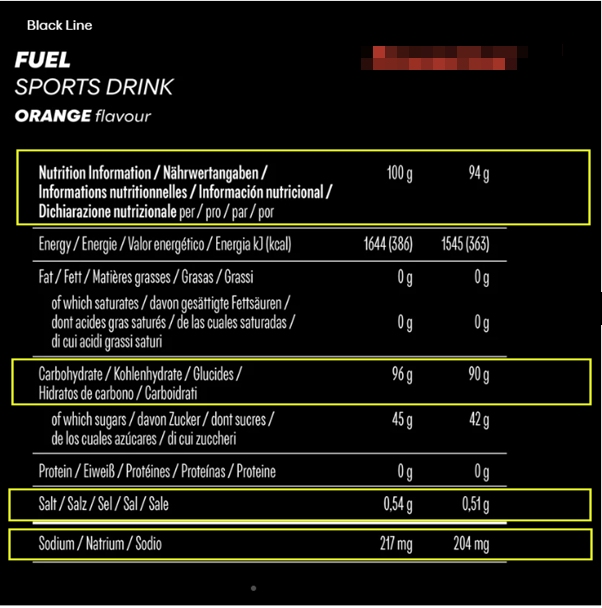
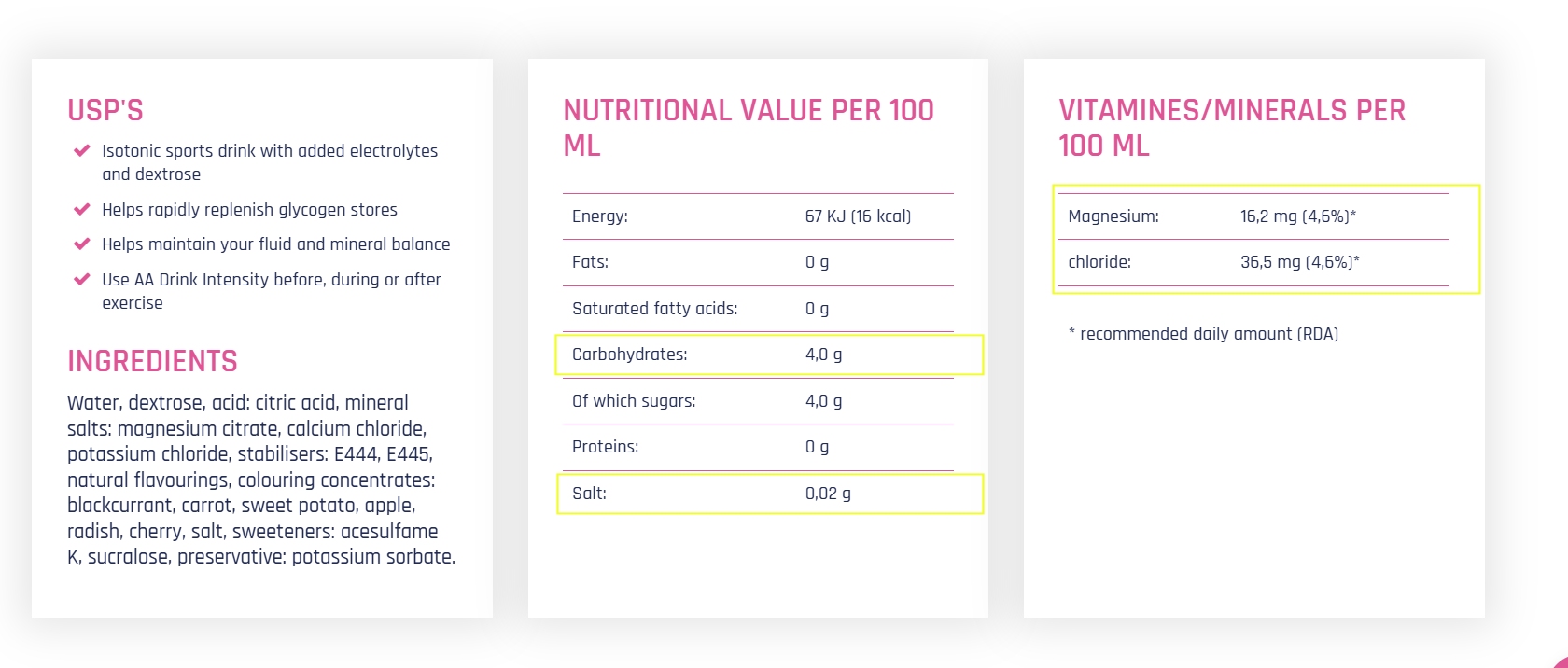
How to evaluate sports drinks: Technical info example
This sports drink provides 4 g carbohydrate and 20 mg salt = 8 mg sodium plus additional magnesium and chloride. 6-8 g carbohydrate and 23-69 mg sodium are required to quench thirst. In this example, the sodium content is too low and the additional minerals will slow down gastric emptying.
Sports Drink Label — Interactive Example
Click or tap each yellow-outlined area to reveal the note.
How to evaluate sports drinks: More Is Not Always Better:
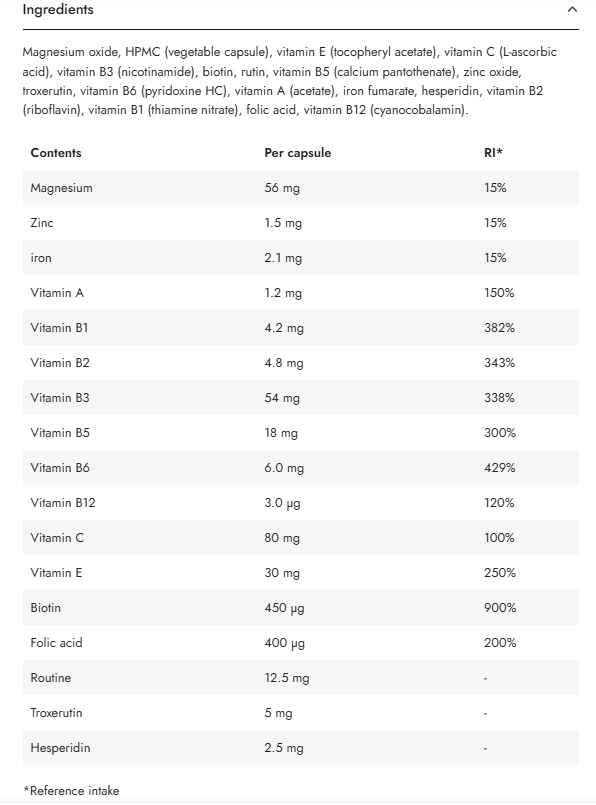
Vitamin and mineral supplements can contain nutrient amounts that greatly exceed the reference intake (RI). Explore the label below and identify nutrients provided at particularly high levels. Open the next example and click on the relevant values to discover why high-dose supplementation may require caution.
Vitamins & Minerals — Interactive Example
Click or tap a nutrient row with a reference intake above 100%.
3.5. Health and Medical Supplements
Used to correct deficiencies diagnosed clinical needs by blood analysis or calculated dietary history by a sports dietitian; should be medically monitored.
- Vitamins: A (vision/immune), D (bone/muscle; test serum levels first), E (antioxidant), K (bone/clotting), B1/Thiamine (energy), B6/Pyridoxine (protein metabolism), Folate/B11 (blood formation), B12/Cobalamin (DNA/nerves), and C/Ascorbic Acid (immunity/collagen), Vitamin D: Vital for bone and immune health. Athletes should test serum 25(OH)D levels. Maintenance requires 800-2.000 IU/day.
- Minerals & Electrolytes
- Iron: Essential for oxygen transport. Warning: Blind supplementation of high-dose iron is dangerous and can lead to toxicity. It is mandatory to perform a blood analysis (Ferritin, Hb, and CRP) before use.
- Calcium (bone health): Athletes with Low Energy Availability (LEA) or bone-stress history require 1.500 mg/day (often paired with Vitamin D) for bone mineralization.
- Magnesium (muscle/nerve function), Zinc (immunity/wound healing), Potassium, and Sodium (Salt).
- Omega-3 (EPA/DHA): Chronic anti-inflammatory and neuroprotective benefits. A daily dose of 1.5-2.0 g/day is required for at least 12 weeks to reach the target Omega-3 Index (O3I) of ≥8%.
3.6. Functional Foods & Recovery
High-quality whole-food alternatives to supplements.
- Dairy: Milk and Chocolate Milk (excellent recovery ratio of carbs/protein). Skyr or Greek Yogurt (concentrated protein, high casein).
- Recovery Aids: Tart Cherry Juice (anti-inflammatory), Gelatine/Collagen (paired with Vitamin C for injury recovery), Curcumin/Turmeric (anti-inflammatory).
- Immunity Support: Probiotics (gut health), Bovine Colostrum (not recommended by WADA due to IGF content), and Beta-Glucans.
3.7. Red Flags and Products to Avoid
Per Regulation 1924/2006, the EFSA only permits generic health claims. You must avoid products utilizing “Unauthorized Claims” such as “burns fat overnight,” “accelerates protein synthesis,” or “increases strength directly.”
- Ashwagandha: Strictly avoid. It is linked to liver toxicity and is a high-risk category for unlisted contaminants.
- Pre-workouts: These are “cocktail” products with an extremely high risk of containing unlisted stimulants or banned substances.
- Internet-sourced Herbal Solutions: Historically a primary source of deliberate adulteration with prohibited substances.
4. Practical Scenarios
4.1. The Youth Cyclist
A 16-year-old male cyclist is asking his mother to buy a supplement to gain more energy during the cycling tournament in the weekend and a supplement to delay the moment that he loosies his alertness. During the week he visits high school and he trains 20 hours in the evening. Because his training in the evening he has difficulties with sleeping. In the morning and during the school days there is only little time to eat.
His mother looks on Internet and finds a few solutions for her son’s problems. She can give him isotonic sports drinks during the tournament and caffein to be alert during school days and tournament.
- Try to make another schedule of training to improve his sleep quality and improve the quality of his breakfast but give him isotonic sport drinks during his training when they last longer than 1 hr. and give him good recovery meals. Be aware that recovery meals can be contaminated with doping substances. It is recommended to visit together with her son a sports dietitian to get personal advice for schooldays and weekend day with and without training so they know what to eat and drink for maximal performance and recovery.
- Give him isotonic sport drinks during the training, give him good recovery meals and try to find out how he reacts on caffein. Be aware that he gets enough time to recover from every training and tournament. Maybe she can visit together with her son a sport dietitian to receive tailored practical information about food and drinks for training and recovery. Be aware that caffein substances can contain doping substances. The safe supplements are always available in a pharmacy.
- Be aware that enough good food and enough sleep is a basic for youth athletes to stay healthy and have a good body composition. Try to make another schedule for his school- and training program and pay enough attention to all meals during the day. Give isotonic drinks during the training and tournament and a good recovery meal afterwards training and tournament sessions. If he doesn’t get nervous from caffein he can also use a bit caffein. Maybe she can visit together with her son a sport dietitian who can advise what is the best nutritional strategy to achieve the ideal body composition. Be aware that all sports supplements can be contaminated with doping substances. Be sure that your supplements are from the right batches of controlled supplements.
- Try to make another schedule for his school- and training and be aware that he gets enough sleep of good quality. If necessary, he can use sports drinks during his training sessions and tournaments and if he doesn’t get nervous from caffein he can also use caffein during the tournaments. Maybe she can visit together with her son a sport dietitian who will give them lots of practical examples to serve him good recovery meals after training and tournament sessions. Be aware that all supplements can be contaminated with doping substances.
What is your advice?
4.2. The Injured Footballer (Recovery and Strength)
A 20-year-old female football player is for six weeks recovering from an ankle fracture. She has an important position in your team and next week you will have a tournament with her team. She discovered on internet that fish oil and protein powder may be beneficial for her recovery. She also discovered that a pre-workout or creatin may be beneficial for her to get more strength in her sore ankle. She promises you not to use the pre-workout on the days of the tournament.
- It is a good idea to use fish oil and a bit ore protein for the recovery of her ankle fracture but taking the pre-workout to gain more strength is not necessary. Besides pre-workouts can be contaminated with doping substances. Creatin can be beneficial, besides the risk of contamination of creatin is lower than contamination of pre-workouts. Fish oil can lower inflammations and be beneficial for the recovery of the fracture. Protein is also beneficial for recovery of bone tissue and ligaments. Maybe she can visit a sport dietitian for a good nutritional advice for her recovery. Be aware that supplements can be contaminated with doping substances.
- Food first is very important. Be sure that the menu of your athlete contains enough protein, antioxidants and fish oil. If she doesn’t succeed to eat enough protein, antioxidants and fish oil it is necessary for her to take supplements that contain these nutrients. A pre-workout can be beneficial to get a bit more strength and creatin can give also a bit more strength. Maybe she can visit a sport dietitian to become inspired with a professional and practical nutritional advice for her recovery. Be aware that all supplements can be contaminated with doping substances.
- Food first is very important. Your athlete must eat good nutritious food with enough protein antioxidants and fish oil during the whole day. If she doesn’t succeed in getting enough of these nutrients she has to add some supplements with these nutrients. Pre-workouts can be beneficial to get more strength and alertness. Creatin can have beneficial effects, but one third of the people don’t have beneficial effects of creatin. Maybe she can visit a sport dietitian to receive a personalized scientific-based nutritional advice for her recovery. Be aware that every supplement can be contaminated with doping substances. Be sure that your supplements are from the right batches of controlled supplements.
- This female football player needs good nutrition with enough protein, antioxidants and fish oil. If she doesn’t succeed to eat enough protein, antioxidants and fish oil, she can use all kinds of supplements that are bought in a pharmacy. She can use a pre-workout until three days for the tournament without any problem. Creatin is also a safe supplement to use and it works for every athlete. Maybe she can visit a sport dietitian to get a tailored practical nutritional advice for her recovery so she can fast rehabilitation.
What is your advice?
4.3. The Judoka (Weight Management)
A 29-year-old judoka wants to lose 3 kg weight in a few days before a tournament to stay in his own weight category. He found on Internet that a herbal solution can help him to lose 3 kg weight in 1-2 days. The supplier of this herbal product will deliver the herbals the next day and it can be ordered by internet. Because this athlete doesn’t want to lose strength he uses creatin and he asks if it is beneficial for him to use a multi vitamin. He also wants to know from you if it is a good idea for him to use less carbs. He asks the advice of the team physical therapist and dietitian.
- First it had been better if he had tried to keep his weight on the highest point of his weight category by eating good nutritious food with enough protein, vitamins and minerals. It is better for him to start earlier with losing weight in a healthy way with avoiding energy-dense food and alcohol and timing meals. Last minute he can eat less salt and fibre and time the intake of carbs around his training sessions. It isn’t a good idea to take this herbal solution, because it can be contaminated with doping substances and other harmful substances. Creatin has in some individuals impact on weight by water retention but can help for his strength. A multi vitamin is only necessary when having an unbalanced diet. The sports dietitian will help him with the practical considerations of the food first approach to get his perfect weight. Contacting the sport dietitian betimes is also important to avoid weight-loss stress.
- Using a herbal solution to lose weight can be a good way without doping risks, because herbs are natural and foods from natural origin never contain doping substances. Herbs are very nutritious and healthy for muscles and immunity, and they have beneficial effects on performance. Multi vitamins are healthier than normal vegetables, because the vegetables contain always too much pesticide. Creatin is always good and has no effect on weight.
- First he’d better tried to keep his weight according to his weight category. Be aware that his food must contain enough protein, and carbs to perform in a good way. It is also necessary to eat enough food with antioxidants. Creatin can help to get a bit more strength, but for one third of the population it doesn’t work. Using creatin can also lead to weight gain due to water retention. Be aware that every nutritional supplement, even the herbal ones can be contaminated with doping substances. It is always necessary to look if it is tested and you need to be sure that you’ve got the right batch that is controlled.
- It is better to keep his weight during the whole season in this own weight category. Using herbal supplements can in some cases be useful to lose weight due to some traits but they can also contain doping substances from natural origin or other harmful substances. They can also be contaminated with doping substances. Creatin can help to gain strength but one third of the people are non-responders on creatin. Creatin can also lead to water retention. Eating les protein can lead to less muscle mass and eating less carbs can lead to less energy end endurance. Vitamins can help to maintain health, but it is preferable to get the vitamins from whole food. Contacting the sport dietitian when experiencing weight maintenance difficulties helps to avoid weight-loss stress.
What is your advice?
Answers: 4.1: C, 4.2: C, 4.3: B
Drag-and-Drop Matching Exercise
Drag one answer into each empty space. Four options are distractors.
Regulatory frameworks
Answer bank
Additional Recommended Material
1. Websites to check the quality of a sports nutrition supplement:
• https://www.dopingautoriteit.nl/nzvt
• https://sport.wetestyoutrust.com/
• https://www.bscg.org/
• https://hasta.org.au/
• https://www.nsfsport.com/
• https://www.sport-protect.org/
• https://www.koelnerliste.com/en/product-database
2. Australian Institute of Sport, About the AIS Sports Supplement Framework (2000-2013): https://www.ausport.gov.au/ais/nutrition/supplements/about-the-ais-sports-supplement-framework#what-is-the-ais-sports-supplement-framework
3. European Food Safety Authority (EFSA) website https://www.efsa.europa.eu/en/topics/health-claims-art-13
4. World Anti-Doping Agency (WADA), prohibited list https://www.wada-ama.org/en/prohibited-list
5. Maughan R.J., Burke LM, Dvorak J, et al (2018). IOC consensus statement: dietary supplements and the high-performance athlete British Journal of Sports Medicine, 52, pp. 439-455, available online at: https://bjsm.bmj.com/content/bjsports/52/7/439.full.pdf